From "400 Million Seniors" to "Several Diaper Changes a Day": Decoding the China Ageing Society Construction Report (2026) and Uncovering the Real Needs of Home-Based Care
Policy Interpretation × Care Implementation × Business Validation — Huayi Medical’s Observation Notes
1. Introduction: When "Ageing Society" Moves from Macro Narratives into the Daily Lives of Families with Disabled Seniors
On July 21, 2026, in Beijing, the China Senior Newspaper, Renmin University of China’s School of Population and Health, and Social Sciences Academic Press jointly released the China Ageing Society Construction Report (2026). The editorial board called it "the first blue book in China focusing on 'ageing society construction'" (Caijing, 2026-07-24).
This report is not just another macro demographic projection. Its structure consists of a "General Report + 7 Special Topics," covering elderly services, elderly security, elderly health, silver economy, smart ageing, age-friendly society construction, and regional development—28 research papers in total. In other words, it breaks down the big issue of "ageing society" into specific tasks that families, communities, institutions, systems, and industries must each tackle.
This article aims to translate the policy language of the blue book into everyday actions like "how many diapers a family with a disabled senior needs to change each day" and "turning over every two hours." We look at three levels: what data the policy presents, what families can do, and how our product lines can meet these needs. It respects both the seriousness of the policy and the reality of frontline caregivers.
1.1 Why Caregivers Should Read This Report
Every percentage point in the report will eventually land in some family’s living room, bedroom, and late night. When "23%" becomes "one of my three elderly family members is already in advanced age," the policy is very close to people.
1.2 Scope of This Article
National and industry data cited in this article come from publicly available official statistics and authoritative media reports (sources listed in the appendix). Specific nursing product parameters are based on general care standards and corporate product practices, which are separate from national standards and cannot substitute for them.
2. Decoding the Report’s Core Findings
2.1 Ageing Countdown to "Severe" Stage: 23.0% → 29.2%
By the end of 2025, China’s population aged 60 and above reached 323 million, accounting for 23.0% of the total population; among them, 224 million were aged 65 and above, accounting for 15.9% (Vice Minister of Civil Affairs speech at Boao Forum / National Healthcare Security Administration statistics, 2026).
The timeline is more noteworthy: It is expected to surpass 400 million around 2031, reaching 29.2%, and enter the severe ageing stage around 2032. "Severe ageing" is not just a slogan—it is a countdown with a clear year, about six years from now.
2.2 Disability Care: The Biggest Unmet Need in This Transformation
First, clarify the definitions, because numbers from different sources vary greatly, and mixing them can mislead judgment:
- Definition ① (CCTV / National Bureau of Statistics): Over 40 million disabled and semi-disabled seniors nationwide.
- Definition ② (People’s Daily Online, 2026-04-22): About 35 million disabled/semi-disabled seniors, around 15 million with cognitive impairment, and over 42 million in advanced age.
- Definition ③ (National Health Commission): Over 45 million disabled and cognitively impaired seniors, roughly 1 in 6 seniors needing long-term care.
This article primarily uses Definition ① (CCTV/NBS) – "over 40 million" – while noting the differences. Regardless of which figure is used, the conclusion is the same: disability care is the hardest and most persistent need in an ageing society.
2.3 Under the "9073" Framework, "Home" Is the Main Battlefield
The "9073" framework repeatedly emphasized by the National Health Commission and the Ministry of Civil Affairs: about 90% of seniors age at home, 7% rely on community services, and 3% live in institutions (National Health Commission / Ministry of Civil Affairs). That means for nine out of ten seniors, the first care setting is always "home." This is why the blue book includes "home-based care supported by in-home services and smart devices for round-the-clock health monitoring" in the pathway for system implementation.
2.4 Home-Based Senior Care Beds × Long-Term Care Insurance: A Dual Engine Accelerating
Two figures best illustrate how "home-based care" is being institutionalized:
- Home-Based Senior Care Beds: By the end of 2025, a cumulative 495,000 beds had been built nationwide, serving over 26 million person-times (Ministry of Civil Affairs, end of 2025); in 2025, 900 million yuan from the central special lottery public welfare fund supported bed construction for economically disadvantaged disabled/semi-disabled seniors.
- Long-Term Care Insurance: In 2025, 308.54 million people were enrolled, with 1.8813 million receiving benefits; the pilot expanded from 15 cities in 2016 to 92 cities; cumulative fund expenditures exceeded 100 billion yuan, benefiting over 3.3 million disabled individuals, with an average annual per-person cost reduction of about 12,000 yuan (National Healthcare Security Administration, 2026). From 2020 to 2024, designated institutions increased from 4,845 to 8,837, and professional caregivers from 191,000 to 293,000, with "long-term care specialist" formally included as an occupation. The policy signal at the system level is even clearer: in March 2026, the General Office of the CPC Central Committee and the General Office of the State Council issued the Opinions on Accelerating the Establishment of a Long-Term Care Insurance System, proposing to basically build a unified national system within about three years.
2.5 Silver Economy: A Window of Over 10 Trillion Yuan
The blue book predicts that the smart elderly care market will be 7.21 trillion yuan in 2025 and could approach 10 trillion yuan by 2028. The Opinions on Developing the Silver Economy to Enhance the Well-being of the Elderly (Guobanfa [2024] No. 1) offers a longer curve: China’s silver economy is about 7 trillion yuan, roughly 6% of GDP, and could reach 30 trillion yuan, about 10% of GDP, by 2035. With both demand side (400 million seniors) and policy side (accelerating institutions) heating up, such certainty is rare in any industry.
3. Implications for "Home-Based Care of Disabled Seniors"
3.1 A Supplies Checklist: The Basic Preparation for Home-Based Care
The blue book’s original wording on system implementation is worth reading word for word by caregivers:
"The ‘medical–rehabilitation–elderly care–nursing’ system is implemented across three scenarios: home, community, and institution. Institutions handle professional care for severely disabled individuals, communities provide daily chronic disease management and short-term respite care, and homes rely on in-home services and smart devices for round-the-clock health monitoring." (Caijing, 2026-07-24)
Note the phrase "homes rely on in-home services." In-home services can bring people in, but daily consumables—diapers, underpads, wipes—must be prepared by the family. This is a threshold many families overlook when first taking on disability care: they think services and insurance are enough, only to find there’s no underpad when leakage happens in the middle of the night.
3.2 Three Types of Seniors, Three Types of Needs: Why Diapers, Underpads, and Wipes Are All Indispensable
According to the degree of disability, seniors can be divided into three categories (corresponding to GB/T 42195-2022 capability assessment level 5 and long-term care insurance evaluation; those with severe and above are mostly level 3 and above receiving benefits—this description is not absolute):
| Senior Type | Disability Level | Core Care Supplies | Selection Points |
|---|---|---|---|
| Can Walk | Mild disability | Pull-up diapers (pants style) | Focus on waist circumference; put on/off like underwear |
| Semi-disabled | Moderate to severe | Adult diapers / tape-on type | Focus on hip circumference; easy to change when lying |
| Long-term bedridden | Severe to complete disability | Adult diapers + underpads + wipes + soft tissues | Underpads catch leaks; wipes for cleaning |
For any category, incontinence care products are the baseline for maintaining skin integrity and dignity—they are not optional extras. Especially for those who are bedridden for a long time, underpads (about 60×90 cm, holding 800–1200 ml) for leak protection, wipes (mildly acidic, pH 5.5–6.5) for cleaning, and soft tissues for patting dry form an unskippable chain.
3.3 Pressure Ulcers and Incontinence-Associated Dermatitis (IAD): Two Preventable "Home Accidents"
The blue book proposes tiered differentiated subsidies: "basic coverage + universal benefits" tilted toward disabled seniors with financial difficulties (Caijing, 2026-07-24), indicating that policy also prioritizes prevention. Two things families can implement:
- Pressure Ulcer Prevention: Turn over every two hours, using a 30° lateral position to avoid prolonged pressure on bony prominences.
- Incontinence-Associated Dermatitis (IAD) Prevention: Follow the three-step method "clean–moisturize–protect": clean promptly after bowel/bladder movements, wipe with warm water or mildly acidic wipes, pat dry, moisturize, then apply a barrier.
Adding these to the family care schedule is far more practical than any anxiety.
4. Huayi · Mengrou Youhucare Product Response
4.1 Six Products Corresponding to the Report’s Three Scenarios
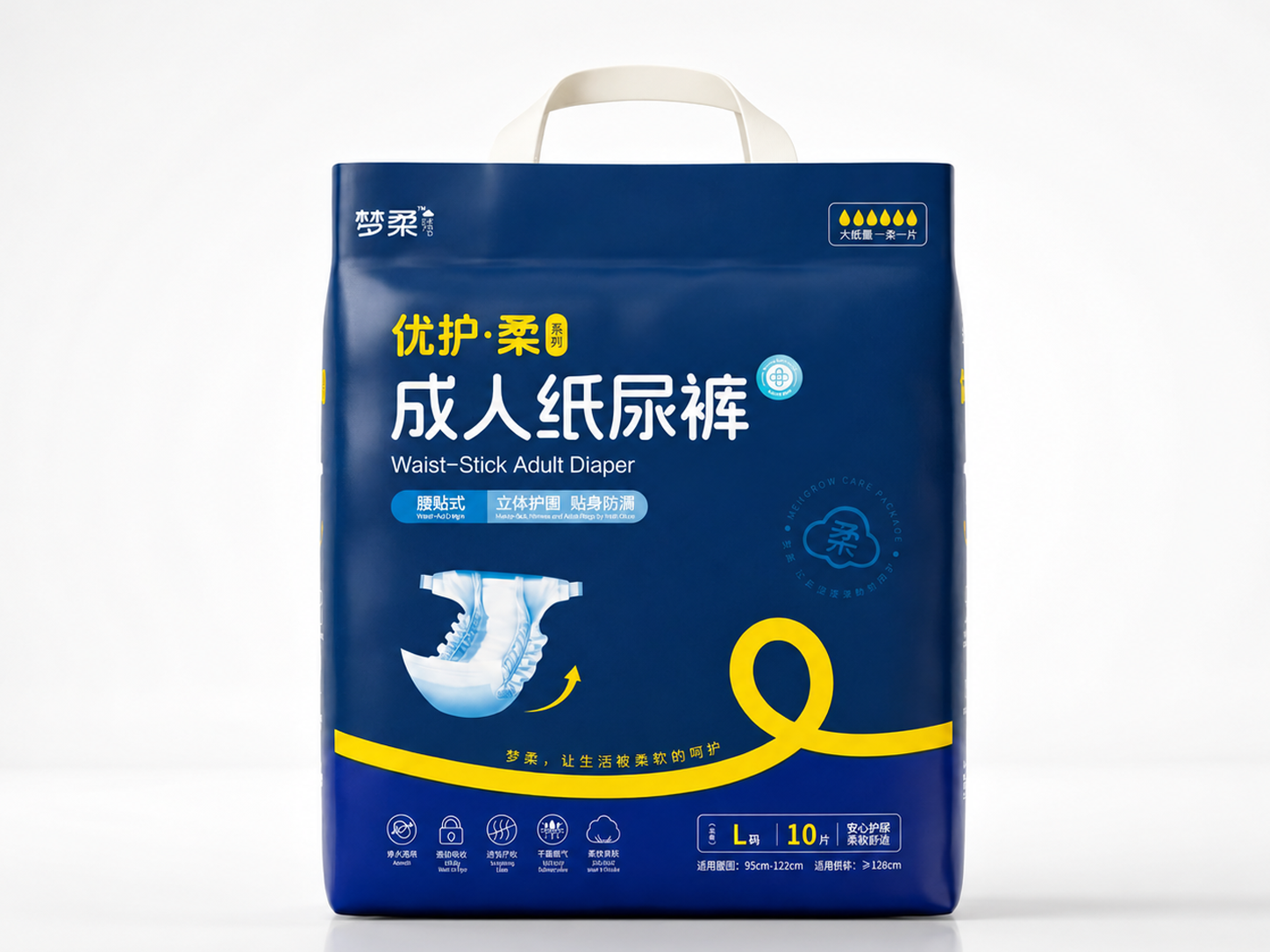
The blue book divides scenarios into home, community, and institution. Corresponding to the specific task of "incontinence care," the Mengrou · Youhucare product line just happens to cover two high-frequency scenarios: home and community:
- Daily Home Use (including home-based senior care beds—the bed connection point in the home scenario): Pull-up diapers (for those who can walk), adult diapers (for bedridden), underpads (bed protection); consumables needed for home-based senior care beds are usually not included in the bed service package and must be prepared by the family per the checklist—this is the key "business validation" connection point (see Section 5 for details).
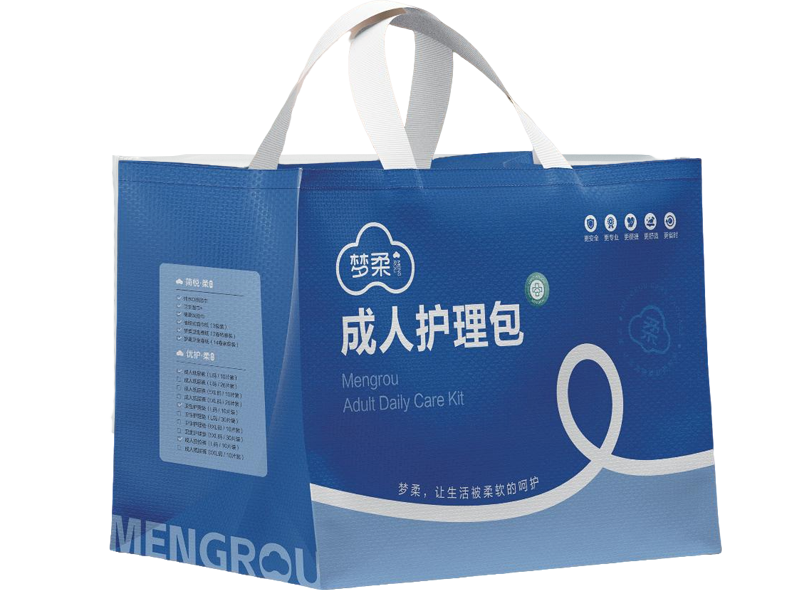
- In-Home Nursing / Community Short-Term Respite Care: Wipes, soft tissues, care packs (portable packages that go with service personnel into homes).
Take Mengrou · Youhucare pull-up diapers as an example: the pants-style design is for mildly disabled seniors who can still walk; selection focuses on waist circumference, put on/off like underwear, preserving their mobility as much as possible. Their underpads (60×90 cm) hold about 800–1200 ml and are used for leak protection on the bed for bedridden individuals, complementing the "turn every two hours" pressure ulcer prevention.
4.2 Our Restrained Stance
Let us be clear: products are "responding to needs" not "creating anxiety." The blue book’s direction of "basic coverage + universal benefits" (Caijing, 2026-07-24) aligns with our positioning—first clarify the real needs, then talk about product selection.
5. Conclusion: From "Ageing Society" to "Age-Friendly Living"
The blue book concludes with a set of methodologies worth remembering: systematic efforts should be made from eight dimensions—"humanistic friendliness, policy friendliness, spatial friendliness, service friendliness, industry friendliness, technology friendliness, participation friendliness, and intergenerational friendliness" (Caijing, 2026-07-24); and nearly 3,000 exemplary age-friendly communities have been established. Grand narratives must ultimately land on the word "friendliness."
For every family caregiver, three actionable suggestions for today:
- First assess the disability level: Refer to GB/T 42195-2022 or your local long-term care insurance evaluation to first determine whether your loved one is "can walk / semi-disabled / bedridden," then talk about supplies.
- Stock a home supplies checklist: Pull-up diapers or adult diapers + underpads + wipes + soft tissues. Based on change frequency (routine every 3–4 hours, watery stools every 2–3 hours, overnight thick type ≤8–12 hours, change immediately after bowel movement), build a home inventory.
- Learn about local policies: Check your local long-term care insurance benefits and home-based senior care bed application conditions—the former reduces the financial burden, the latter brings professional care into the home, but consumables still need to be prepared by the family.
The countdown to "severe" ageing has begun. What we can do is translate every percentage point into the underpad that family can use tonight, that turn over, and that sentence: "I know it’s not easy for you."
6. Appendix
6.1 List of Citation Sources
- Caijing: Report on China Ageing Society Construction Report (2026), 2026-07-24 (blue book release information and original core statements).
- Ministry of Civil Affairs / National Healthcare Security Administration: Ageing population data and long-term care insurance data, 2026 (Boao Forum speech, statistical bulletin definitions).
- Ministry of Civil Affairs: 495,000 home-based senior care beds, serving over 26 million person-times, end of 2025; 900 million yuan from central special lottery public welfare fund, 2025.
- National Healthcare Security Administration: Long-term care insurance enrollment 308.54 million, beneficiaries 1.8813 million, cumulative fund expenditures over 100 billion yuan, benefiting over 3.3 million individuals, annual per-person cost reduction about 12,000 yuan; designated institutions from 4,845 to 8,837, caregivers from 191,000 to 293,000, 2020–2024.
- General Office of the CPC Central Committee and General Office of the State Council: Opinions on Accelerating the Establishment of a Long-Term Care Insurance System, March 2026.
- National Health Commission / Ministry of Civil Affairs: "9073" elderly care framework; over 45 million disabled/cognitively impaired seniors, 1 in 6 seniors needing long-term care.
- CCTV / National Bureau of Statistics: Over 40 million disabled and semi-disabled seniors.
- People’s Daily Online: About 35 million disabled/semi-disabled, 15 million cognitively impaired, over 42 million advanced age, 2026-04-22.
- Guobanfa [2024] No. 1: Opinions on Developing the Silver Economy to Enhance the Well-being of the Elderly.
- Social Sciences Academic Press / China Senior Newspaper / Renmin University of China School of Population and Health: Joint publishers of the blue book, July 21, 2026, Beijing.
6.2 Disclaimer
- This article is AI-assisted and is intended solely for policy interpretation and caregiving science popularization. It does not constitute medical diagnosis or treatment advice.
- Demographic and institutional data cited in the text come from publicly available official statistics and authoritative media reports; the final version shall be subject to official releases.
- Specific care plans, change frequencies, and product choices should be tailored to the individual senior’s condition and follow medical/professional caregiver guidance.
- Product parameters mentioned are based on corporate practice and general care standards, not equivalent to national standards; for purchasing, refer to the actual product specifications.